
what is seo

Create a clean, modern infographic illustration in a 3:2 aspect ratio, full-bleed layout, wide horizontal composition, no poster frame, no narrow centered stack. Use a professional white background with blue, teal, and dark navy accents, subtle light-gray dividers, bold sans-serif headline, and clear hierarchy.

Top header across the full width:
Large bold title text: "What Is SEO?"
Smaller subtitle directly below: "A Plain-English Guide for Beginners"

Main body arranged in 4 wide horizontal content blocks or columns with clear numbered labels and icons:

1. Left block with a magnifying glass and website icon:
Heading text: "1. SEO = Search Engine Optimization"
Body text: "Getting your website to show up higher on Google and other search engines"
Small badge text: "Without paying for ads"

2. Second block with a rising arrow and search results icon:
Heading text: "2. How SEO works"
Body text: "Helps search engines understand, rank, and recommend your content"

3. Third block with three small stacked icons and labels:
Heading text: "3. Key things to learn"
Three short bullet lines:
"Types of SEO"
"Key ranking components"
"Common mistakes to avoid"

4. Right block with a group of people, chart, and warning icons:
Heading text: "4. Why SEO matters"
Three short bullet lines:
"Bloggers"
"Small business owners"
"Marketers and creators"
Small footer line inside the block: "More people find your content online"

Bottom strip spanning the width with a simple checklist icon:
Bold line of text: "No jargon. No fluff. Just what you actually need to know."

Use clean spacing, strong visual separation, readable typography, and icons aligned beside each heading. Keep all text exact and clearly legible.

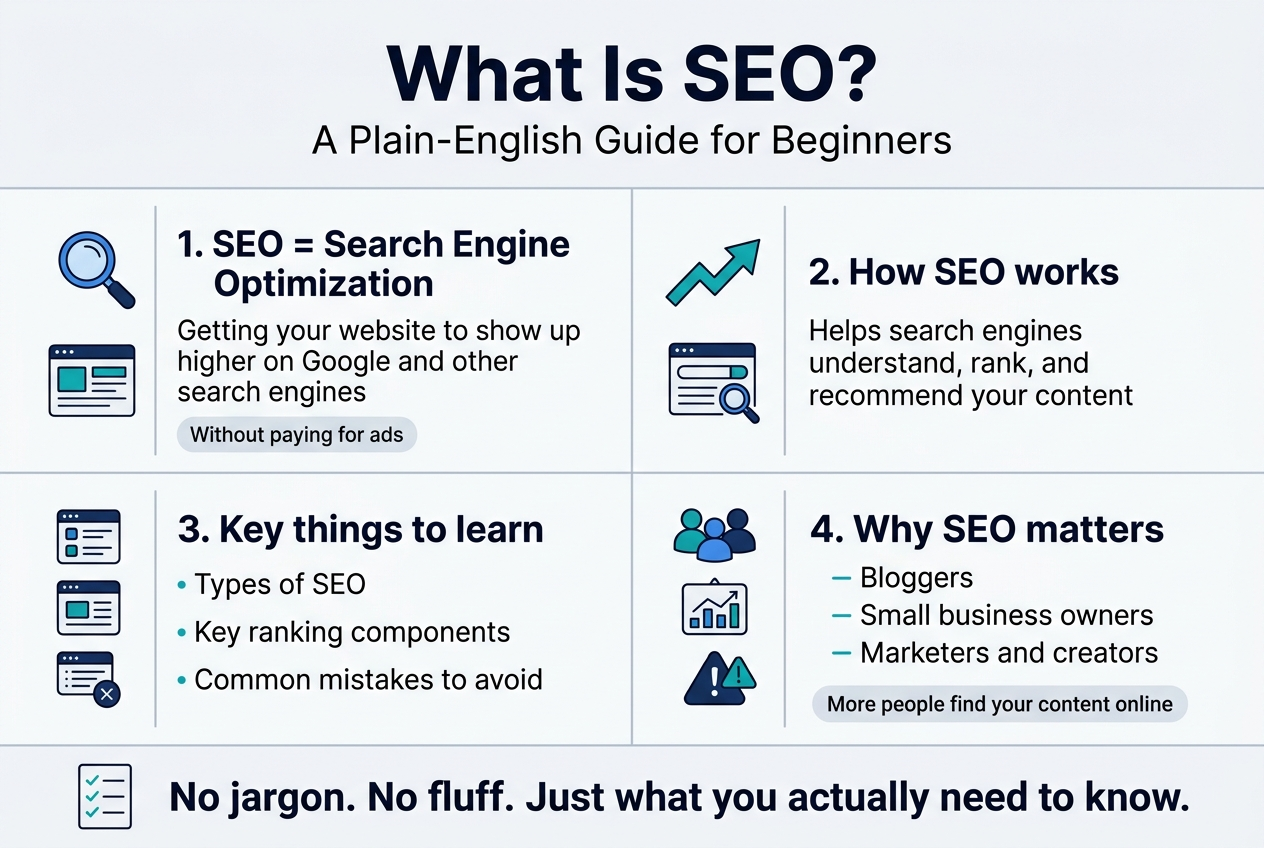
What Is SEO? A Plain-English Guide for Beginners

If you’ve heard the term SEO thrown around but still aren’t sure what it actually means, you’re in the right place.

SEO, or search engine optimization, is the process of getting your website to show up higher on Google and other search engines — without paying for ads. It’s a skill that matters for bloggers, small business owners, marketers, and anyone who wants more people to find their content online.

In this guide, you’ll learn exactly how SEO works, the different types you should know about, and the key components that make a website rank. You’ll also walk away knowing the real benefits SEO delivers and the common mistakes that quietly kill a site’s chances of ranking.

No jargon. No fluff. Just what you actually need to know.

Understanding the Core Concept of SEO
Create a clean, modern infographic illustration in a 3:2 aspect ratio, full-bleed layout with no outer frame, using a professional flat-vector style. Use a white background with blue, teal, and dark navy accents, subtle gray dividers, and bold sans-serif typography.

Top header across the full width:
Large bold title in dark navy: "Understanding the Core Concept of SEO"
Smaller subtitle beneath in teal: "The Simple Definition of SEO and Why It Matters"

Main body arranged in three wide horizontal sections or columns with clear spacing, not a narrow vertical stack:

1) Left section with a blue circular icon of a magnifying glass over a website window.
Heading: "What SEO Means"
Body text in short lines:
"SEO (Search Engine Optimization) is the practice of improving your website so it shows up higher in search results when people look for topics related to your business."
"More clicks mean more potential customers, readers, or leads"
"without paying for ads."

2) Center section with a teal circular icon showing a search engine crawler/spider scanning web pages, then an index/database and ranked results arrows.
Heading: "How Search Engines Work"
Body text in short lines:
"1. Crawlers or spiders scan websites across the internet"
"2. Content is stored in a massive index"
"3. Search results are ranked by relevance, quality, speed, and trustworthiness"

3) Right section with a three-part connected diagram using icons:
- user silhouette with a search bar
- search engine logo-style circle with ranking results
- website owner with a gear and webpage
Heading: "The Key Players"
Three labeled blocks with arrows between them:
"Users" — "Type queries and expect fast, accurate answers"
"Search Engines" — "Match user intent with the best available content"
"Website Owners" — "Optimize content to meet both user needs and search engine criteria"

At the bottom, add a highlighted navy callout bar spanning the width with white text:
"When all three align — your content answers what users are searching for, in a way search engines can read — that's when SEO really starts working."

Use clear section dividers, simple

The Simple Definition of SEO and Why It Matters

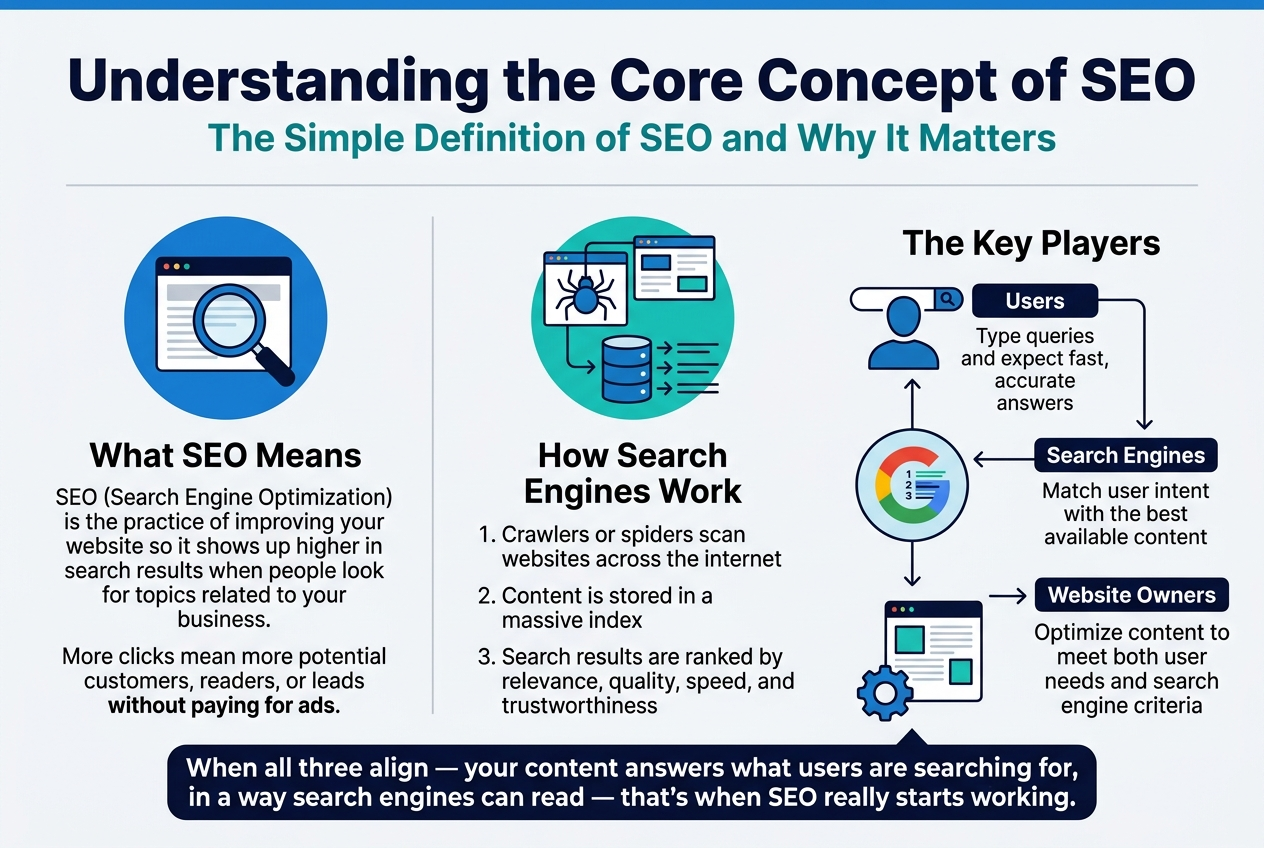
SEO (Search Engine Optimization) is the practice of improving your website so it shows up higher in search results when people look for topics related to your business. The higher you rank, the more people click through — and more clicks mean more potential customers, readers, or leads, without paying for ads.

How Search Engines Work to Find and Rank Content

Search engines like Google use automated programs called crawlers or spiders to scan websites across the internet. Once they find your content, they store it in a massive index. When someone searches, Google pulls from that index and ranks results based on hundreds of factors — relevance, quality, speed, and trustworthiness among them.

The Key Players: Users, Search Engines, and Website Owners

SEO works because of three interconnected parties:

Player Role
Users Type queries and expect fast, accurate answers
Search Engines Match user intent with the best available content
Website Owners Optimize content to meet both user needs and search engine criteria

When all three align — your content answers what users are searching for, in a way search engines can read — that’s when SEO really starts working.

The Main Types of SEO You Need to Know

On-Page SEO: Optimizing What Is on Your Website
Aspect ratio 3:2, full-bleed clean professional infographic, white background with subtle light-gray grid texture, modern sans-serif fonts, strong visual hierarchy, bold dark navy title at top center: "The Main Types of SEO You Need to Know"

Below the title, create four wide horizontal content panels arranged in a 2x2 grid across the page, each with a colored header bar, a large icon on the left, and short text on the right.

Panel 1 in blue: icon of a webpage with a magnifying glass. Heading text: "On-Page SEO". Subheading text: "Optimizing What Is on Your Website". Body text: "Content, headings, keyword placement, meta titles, descriptions, and internal links. When your content directly answers what people are searching for, search engines take notice and rank you higher."

Panel 2 in orange: icon of a chain link and upward arrow. Heading text: "Off-Page SEO". Subheading text: "Building Authority Beyond Your Website". Body text: "Backlinks from trusted websites signal to Google that your content is worth recommending. Social shares, brand mentions, and guest posts all contribute to how authoritative your site appears."

Panel 3 in teal: icon of a gear inside a smartphone and speed lines. Heading text: "Technical SEO". Subheading text: "Strengthening the Foundation of Your Site". Body text in four short bullet points with small check icons:
"Page speed — faster sites rank better and keep visitors around"
"Mobile-friendliness — most searches happen on phones"
"Crawlability — search engines need to read and index your pages"
"Secure connections (HTTPS) — a basic trust signal Google expects"

Panel 4 in green: icon of a map pin with a storefront and star rating. Heading text: "Local SEO". Subheading text: "Reaching Customers in Your Area". Body text: "If you run a physical business or serve a specific region, local SEO helps you show up when nearby customers search. Optimizing your Google Business Profile, collecting reviews, and using location-specific keywords puts you in front of the right people at the right moment."

Add a slim bottom strip with four small matching icons and labels

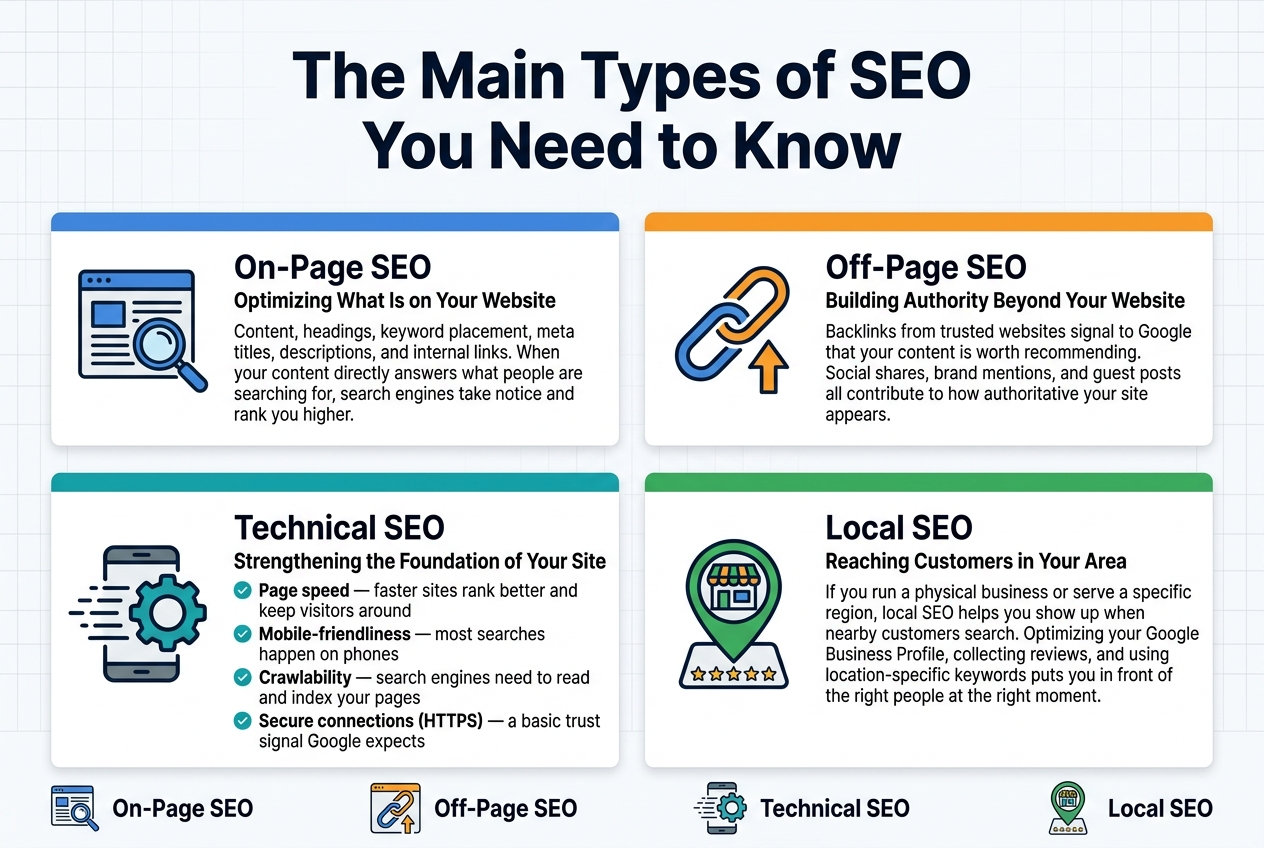
This covers everything visible on your pages — content, headings, keyword placement, meta titles, descriptions, and internal links. When your content directly answers what people are searching for, search engines take notice and rank you higher.

Off-Page SEO: Building Authority Beyond Your Website

Think of this as your site’s reputation on the internet. Backlinks from trusted websites signal to Google that your content is worth recommending. Social shares, brand mentions, and guest posts all contribute to how authoritative your site appears.

Technical SEO: Strengthening the Foundation of Your Site

Even great content fails if your site is slow or broken. Technical SEO addresses:

  • Page speed — faster sites rank better and keep visitors around
  • Mobile-friendliness — most searches happen on phones
  • Crawlability — search engines need to read and index your pages
  • Secure connections (HTTPS) — a basic trust signal Google expects

Local SEO: Reaching Customers in Your Area

If you run a physical business or serve a specific region, local SEO helps you show up when nearby customers search. Optimizing your Google Business Profile, collecting reviews, and using location-specific keywords puts you in front of the right people at the right moment.

Core Components That Drive SEO Success
Create a clean, professional full-bleed infographic illustration in 3:2 aspect ratio with a light background, modern sans-serif fonts, and a clear visual hierarchy. Place a bold title across the top: "Core Components That Drive SEO Success". Use a wide horizontal layout with three large color-coded sections across the page, not a narrow vertical poster. Include SEO-themed icons, arrows, and simple diagrams.

LEFT SECTION: "Keywords: Connecting Your Content to What People Search"
Show a magnifying glass, search bar, and keyword tags. Include these exact lines:
"Keywords are the bridge between what your audience types into Google and the content you create."
"Short-tail keywords" – "e.g., 'shoes'" – "high volume, fierce competition"
"Long-tail keywords" – "e.g., 'best running shoes for flat feet'" – "lower volume, higher intent, easier to rank"
"Place keywords naturally in titles, headings, and throughout your content"
Use small tag icons and an arrow from search bar to webpage content.

CENTER SECTION: "Quality Content: The Driving Force Behind Higher Rankings"
Show a document/checklist icon, star, and upward ranking arrow. Include these exact lines:
"Google's job is to serve the best answer to any question."
"Great content is:"
"Accurate and well-researched"
"Easy to read and scan"
"Answering real questions your audience has"
"Thin, recycled content gets ignored."
"Original, helpful content gets shared, linked to, and ranked."
Use three checkmark bullets for the three qualities.

RIGHT SECTION: "Backlinks: Why Other Websites Vouching for You Matters"
Show connected website nodes, chain-link icons, and a trust badge. Include these exact lines:
"A backlink is when another website links to yours."
"Think of it as a vote of confidence"
"The more credible sites linking to you, the more Google trusts your site."
Add a small clean table with headers:
"Backlink Type" and "Impact"
Rows:
"High-authority site" | "Very strong"
"Relevant niche site" | "Strong"

Keywords: Connecting Your Content to What People Search

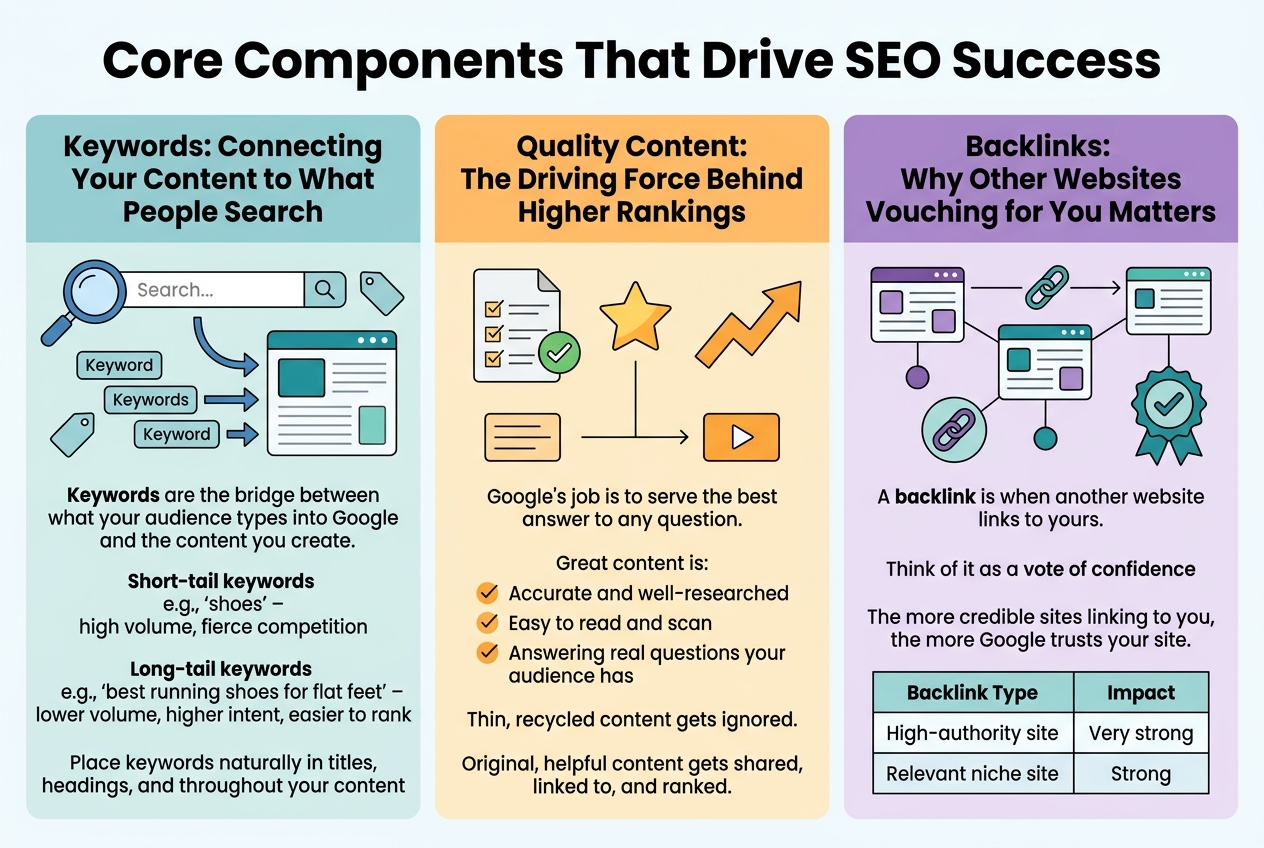
Keywords are the bridge between what your audience types into Google and the content you create. They signal to search engines what your page is actually about.

  • Short-tail keywords (e.g., “shoes”) – high volume, fierce competition
  • Long-tail keywords (e.g., “best running shoes for flat feet”) – lower volume, higher intent, easier to rank

The goal isn’t stuffing keywords everywhere — it’s placing them naturally in titles, headings, and throughout your content where they actually make sense.


Quality Content: The Driving Force Behind Higher Rankings

Google’s job is to serve the best answer to any question. If your content genuinely helps people, search engines reward you for it.

Great content is:

  • Accurate and well-researched
  • Easy to read and scan
  • Answering real questions your audience has

Thin, recycled content gets ignored. Original, helpful content gets shared, linked to, and ranked.


Backlinks: Why Other Websites Vouching for You Matters

A backlink is when another website links to yours. Think of it as a vote of confidence — the more credible sites linking to you, the more Google trusts your site.

Not all backlinks are equal:

Backlink Type Impact
High-authority site Very strong
Relevant niche site Strong
Spammy/irrelevant site Can hurt rankings

Earning quality backlinks through great content and genuine outreach remains one of the fastest ways to climb search rankings.

The Proven Benefits of Investing in SEO
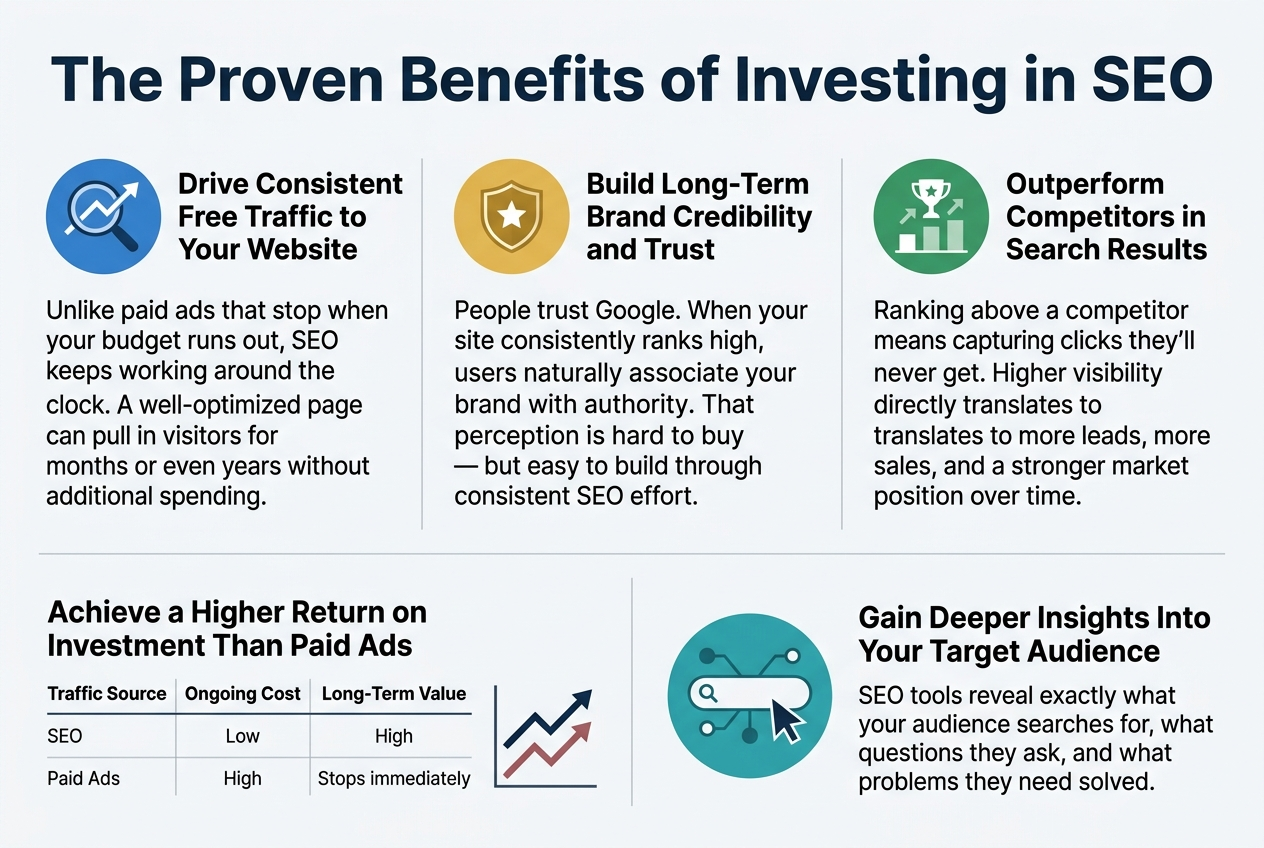
Create a clean, professional full-bleed infographic illustration in 3:2 aspect ratio with a modern white background, deep navy and teal accents, subtle light gray dividers, and bold sans-serif typography. Place a large bold headline across the top: "The Proven Benefits of Investing in SEO". Use a wide horizontal layout with five clearly separated sections arranged in a 2-row grid: three sections across the top row and two wider sections across the bottom row. Add simple flat vector icons for each section.

Top row, left section:
A blue circular icon with a magnifying glass and upward traffic line.
Heading: "Drive Consistent Free Traffic to Your Website"
Body text: "Unlike paid ads that stop when your budget runs out, SEO keeps working around the clock. A well-optimized page can pull in visitors for months or even years without additional spending."

Top row, center section:
A gold circular icon with a shield and star.
Heading: "Build Long-Term Brand Credibility and Trust"
Body text: "People trust Google. When your site consistently ranks high, users naturally associate your brand with authority. That perception is hard to buy — but easy to build through consistent SEO effort."

Top row, right section:
A green circular icon with a trophy and arrows above a competitor bar chart.
Heading: "Outperform Competitors in Search Results"
Body text: "Ranking above a competitor means capturing clicks they'll never get. Higher visibility directly translates to more leads, more sales, and a stronger market position over time."

Bottom row, left wide section:
A split comparison graphic with two columns and a small chart icon.
Heading: "Achieve a Higher Return on Investment Than Paid Ads"
Include a simple table with exact text:
"Traffic Source | Ongoing Cost | Long-Term Value"
"SEO | Low | High"
"Paid Ads | High | Stops immediately"
Add a small upward profit line graph beside the table. Use dark blue for SEO and muted red for Paid Ads.

Bottom row, right wide section:
A teal circular icon with a search bar, cursor, and data nodes.
Heading: "Gain Deeper Insights Into Your Target Audience"
Body text: "SEO tools reveal exactly what your audience searches for, what questions they ask, and what problems they

Drive Consistent Free Traffic to Your Website

Unlike paid ads that stop the moment your budget runs out, SEO keeps working around the clock. A well-optimized page can pull in visitors for months or even years without additional spending.

Build Long-Term Brand Credibility and Trust

People trust Google. When your site consistently ranks high, users naturally associate your brand with authority. That perception is hard to buy — but easy to build through consistent SEO effort.

Outperform Competitors in Search Results

Ranking above a competitor means capturing clicks they’ll never get. Higher visibility directly translates to more leads, more sales, and a stronger market position over time.

Achieve a Higher Return on Investment Than Paid Ads

Traffic Source Ongoing Cost Long-Term Value
SEO Low High
Paid Ads High Stops immediately

Organic traffic typically delivers better ROI because the cost per acquisition drops significantly as your rankings mature.

Gain Deeper Insights Into Your Target Audience

SEO tools reveal exactly what your audience searches for, what questions they ask, and what problems they need solved. That data shapes smarter content, better products, and sharper marketing across every channel.

How SEO Works in Practice
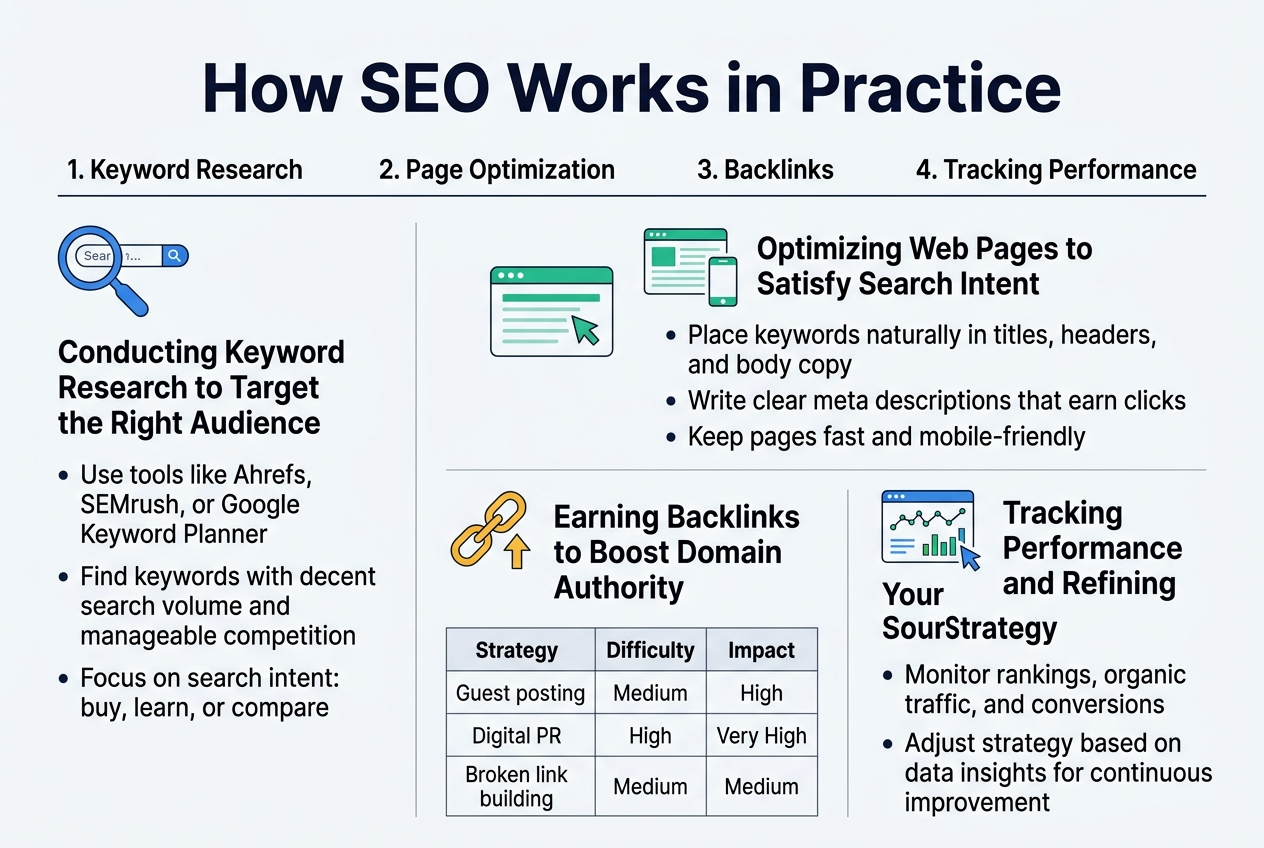
Create a clean professional infographic illustration in a 3:2 aspect ratio, full-bleed background with no poster frame, no large margins, and a wide horizontal layout using four balanced sections across the canvas. Use a modern sans-serif font, strong hierarchy, white background with blue, teal, green, and orange accents, subtle gray dividers, and flat vector icons.

Top center: bold large title text in dark navy: "How SEO Works in Practice"

Under the title, a thin horizontal line and a small subtitle row with four numbered labels spaced across the width:
"1. Keyword Research" | "2. Page Optimization" | "3. Backlinks" | "4. Tracking Performance"

Section 1 on the left with a blue magnifying glass icon and a small search bar graphic:
Heading text: "Conducting Keyword Research to Target the Right Audience"
Body text in three short bullet points:
"Use tools like Ahrefs, SEMrush, or Google Keyword Planner"
"Find keywords with decent search volume and manageable competition"
"Focus on search intent: buy, learn, or compare"

Section 2 upper middle-right with a green webpage/browser icon and a small mobile phone icon:
Heading text: "Optimizing Web Pages to Satisfy Search Intent"
Body text in three short bullet points:
"Place keywords naturally in titles, headers, and body copy"
"Write clear meta descriptions that earn clicks"
"Keep pages fast and mobile-friendly"

Section 3 lower left-center with a gold chain-link icon and upward arrow:
Heading text: "Earning Backlinks to Boost Domain Authority"
Add a simple 3-column mini table beneath it with clean grid lines and bold column headers:
"Strategy" | "Difficulty" | "Impact"
"Guest posting" | "Medium" | "High"
"Digital PR" | "High" | "Very High"
"Broken link building" | "Medium" | "Medium"

Section 4 lower right with a dashboard analytics icon showing chart lines, traffic bars, and a cursor:
Heading text: "Tracking Performance and Refining Your Strategy"
Body text in two short bullet points:
"Monitor rankings, organic traffic

Conducting Keyword Research to Target the Right Audience

Keyword research is where everything starts. You figure out exactly what your audience types into Google, then build your content around those queries.

Key steps:

  • Use tools like Ahrefs, SEMrush, or Google Keyword Planner
  • Look for keywords with decent search volume but manageable competition
  • Focus on search intent — are people looking to buy, learn, or compare?

Optimizing Web Pages to Satisfy Search Intent

Once you have your keywords, every page needs to deliver what the searcher actually wants. Match your content format, depth, and angle to what’s already ranking.

  • Place keywords naturally in titles, headers, and body copy
  • Write clear meta descriptions that earn clicks
  • Keep pages fast and mobile-friendly

Earning Backlinks to Boost Domain Authority

Backlinks act like votes of confidence from other websites. The more quality sites linking to you, the more Google trusts your content.

Strategy Difficulty Impact
Guest posting Medium High
Digital PR High Very High
Broken link building Medium Medium

Tracking Performance and Refining Your Strategy

SEO isn’t a one-time job. Monitor rankings, organic traffic, and conversions through Google Search Console and Analytics, then double down on what’s working.

Common SEO Mistakes That Hold Websites Back
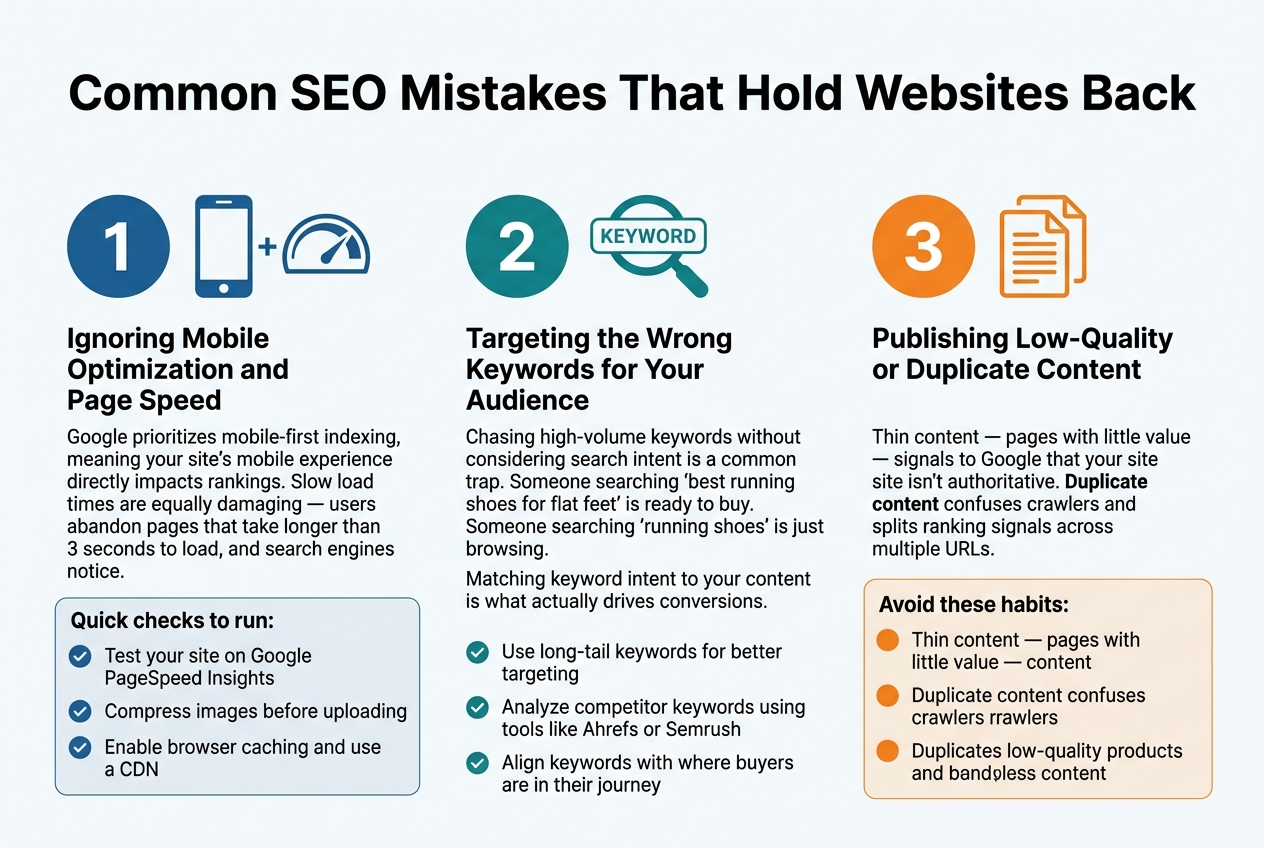
Create a clean professional SEO infographic in a full-bleed 3:2 landscape layout with a modern white background, deep blue and teal accents, orange warning highlights, and dark gray sans-serif typography. Place a bold large title across the top center: "Common SEO Mistakes That Hold Websites Back". Use a clear visual hierarchy with three wide horizontal sections arranged in three equal columns across the page, each with a large numbered circle icon and a simple flat icon.

Left section: a blue circle with the number "1" and a smartphone plus speedometer icon. Heading text: "Ignoring Mobile Optimization and Page Speed". Under it, include smaller body text: "Google prioritizes mobile-first indexing, meaning your site's mobile experience directly impacts rankings. Slow load times are equally damaging — users abandon pages that take longer than 3 seconds to load, and search engines notice." Add a subheading box: "Quick checks to run:" followed by three bullet lines with small check icons: "Test your site on Google PageSpeed Insights", "Compress images before uploading", "Enable browser caching and use a CDN".

Middle section: a teal circle with the number "2" and a magnifying glass over a keyword tag icon. Heading text: "Targeting the Wrong Keywords for Your Audience". Under it, include smaller body text: "Chasing high-volume keywords without considering search intent is a common trap. Someone searching \"best running shoes for flat feet\" is ready to buy. Someone searching \"running shoes\" is just browsing. Matching keyword intent to your content is what actually drives conversions." Add three bullet lines with small check icons: "Use long-tail keywords for better targeting", "Analyze competitor keywords using tools like Ahrefs or Semrush", "Align keywords with where buyers are in their journey".

Right section: an orange circle with the number "3" and a document stack with a duplicate pages icon. Heading text: "Publishing Low-Quality or Duplicate Content". Under it, include smaller body text: "Thin content — pages with little value — signals to Google that your site isn't authoritative. Duplicate content confuses crawlers and splits ranking signals across multiple URLs." Add a subheading box: "Avoid these habits:" followed by three bullet lines with

Ignoring Mobile Optimization and Page Speed

Google prioritizes mobile-first indexing, meaning your site’s mobile experience directly impacts rankings. Slow load times are equally damaging — users abandon pages that take longer than 3 seconds to load, and search engines notice.

Quick checks to run:

Targeting the Wrong Keywords for Your Audience

Chasing high-volume keywords without considering search intent is a common trap. Someone searching “best running shoes for flat feet” is ready to buy. Someone searching “running shoes” is just browsing. Matching keyword intent to your content is what actually drives conversions.

  • Use long-tail keywords for better targeting
  • Analyze competitor keywords using tools like Ahrefs or Semrush
  • Align keywords with where buyers are in their journey

Publishing Low-Quality or Duplicate Content

Thin content — pages with little value — signals to Google that your site isn’t authoritative. Duplicate content confuses crawlers and splits ranking signals across multiple URLs.

Avoid these habits:

  • Copying manufacturer descriptions word-for-word
  • Publishing near-identical pages targeting similar keywords
  • Skipping original research, examples, or genuine expertise in your writing
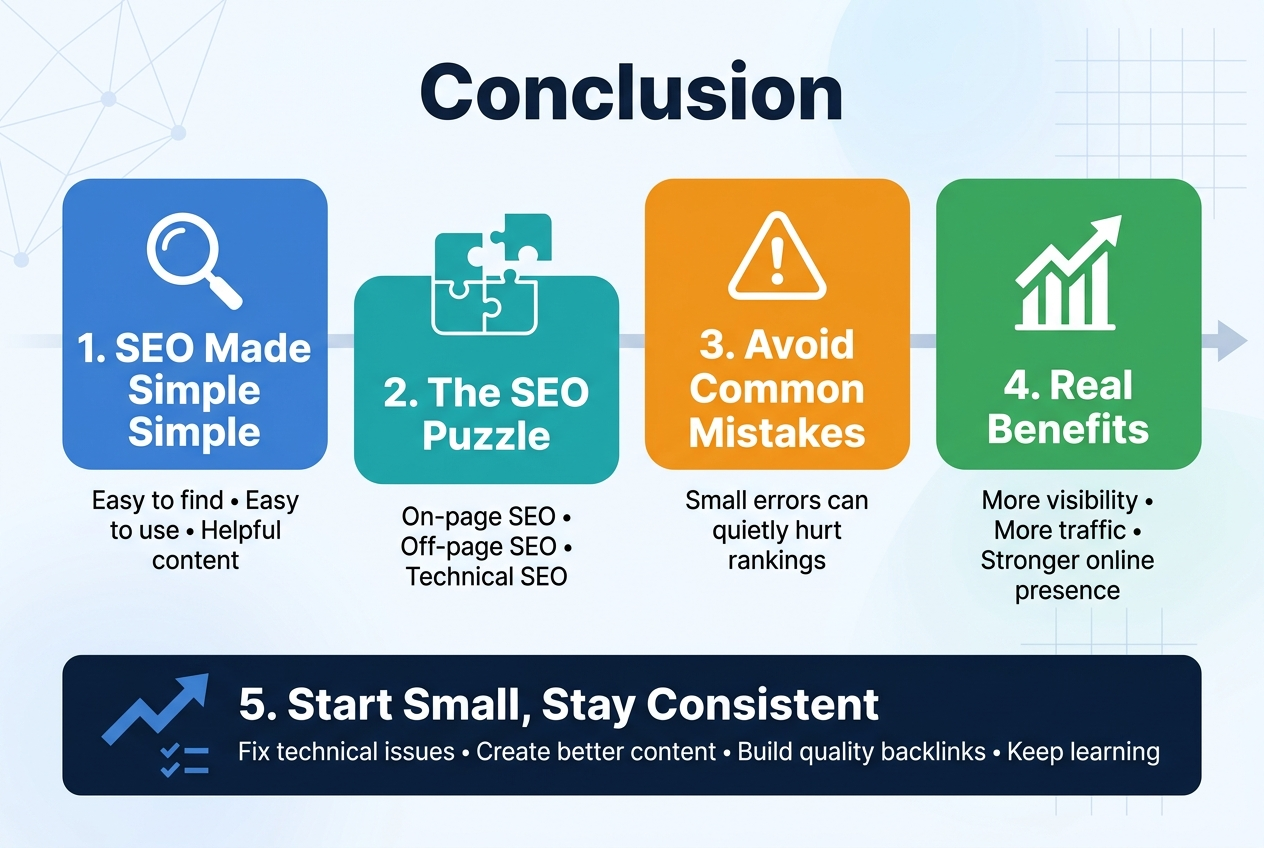
Create a clean, professional infographic illustration in a 3:2 aspect ratio with a full-bleed layout, no frame, using a modern flat vector style. Background: soft white with subtle light-blue gradient accents and faint network/grid patterns. Use a bold sans-serif font with strong visual hierarchy.

Top center: large bold heading in dark navy text: "Conclusion"

Below the heading, arrange the content in a wide 2-row layout with 4 main color-coded sections and a final wide bottom banner. Use clear icons and numbered points. Avoid a narrow centered stack.

Section 1 on the upper left: a blue rounded rectangle with a magnifying glass icon and the title in bold: "1. SEO Made Simple"
Include smaller text beneath: "Easy to find • Easy to use • Helpful content"

Section 2 on the upper middle-left: a teal rounded rectangle with three connected puzzle-piece icons and the title in bold: "2. The SEO Puzzle"
Include smaller text beneath: "On-page SEO • Off-page SEO • Technical SEO"

Section 3 on the upper middle-right: an orange rounded rectangle with a warning triangle icon and the title in bold: "3. Avoid Common Mistakes"
Include smaller text beneath: "Small errors can quietly hurt rankings"

Section 4 on the upper right: a green rounded rectangle with an upward-trending chart icon and the title in bold: "4. Real Benefits"
Include smaller text beneath: "More visibility • More traffic • Stronger online presence"

Bottom wide banner across the full width: a dark navy bar with a growth arrow and checklist icons on the left. Bold white text: "5. Start Small, Stay Consistent"
Smaller white text below: "Fix technical issues • Create better content • Build quality backlinks • Keep learning"

Add a subtle horizontal timeline or arrow flow connecting the sections from left to right, suggesting progress over time. Use crisp icons, balanced spacing, and strong contrast. Make the design polished, educational, and easy to scan.

SEO doesn’t have to feel like a mystery. At its core, it’s about making your website easy to find, easy to use, and packed with content that actually helps people. From understanding the difference between on-page, off-page, and technical SEO to avoiding the common mistakes that quietly tank your rankings, every piece of the puzzle matters. The benefits are real — more visibility, more traffic, and a stronger online presence that builds over time.

The best part? You don’t need to get everything perfect right away. Start small, stay consistent, and keep learning as you go. Whether you fix a few technical issues, create better content, or build some quality backlinks, every step moves you in the right direction. SEO is a long game, but the payoff is absolutely worth it.


Leave a Comment

Your email address will not be published. Required fields are marked *

Scroll to Top